Cave system in Fayette County becomes Pennsylvania state park
David Cale and his family donated more than 400 acres to the state, ending decades of private ownership and preserving a major underground site.
By Daniel Kim ·
A sprawling cave system in Fayette County, Pennsylvania, officially became a state park after a local family donated more than 400 acres of land to the Department of Natural Resources earlier this year.
Laurel Caverns is the largest known cave system in the state, covering approximately four miles. The site sits beneath what was once the family farm of David Cale, an 81-year-old retired physics professor.
Cale married Lillian Cale, a teacher, nearly 50 years ago. They met when she brought her class on a field trip to the caves. The couple has now handed the property over to state management.
Visitors enter the caverns through a door in a visitor center built partially into the rock. Once underground, the stone ceiling forms a cathedral-like shape. Cale said the rock is over 100 million years older than the Appalachian Mountains themselves.
According to Cale, the rock was buckled upward when the mountains formed. Groundwater then dissolved the stone over millions of years. He noted that the mountain is eroding at a rate of about three inches every thousand years.
Cale first entered the caves for his birthday party in 1946. He began exploring alone at age 7. By his teens, he was helping his grandfather and father expand access to the system. In 1957, they worked on digs to break through into new parts of the cave.
For decades, Cale operated the site as if it were a government park. He installed signage with white lettering on brown backgrounds, mimicking federal park styles. When the state took over the land, officials kept most of those signs inside the cave exactly as they were.
Cale said he avoided turning the site into a quarry to prevent short-term profit from damaging the cavern. He noted that cave tours have been in operation for 60 years and can continue for another 60 with similar economic impact on the community.
Emily Davis, a longtime caver who advises the National Speleological Association, said show caves helped start the modern push for cave conservation. She explained that caves are important natural habitats for hibernating bats and species like cave salamanders.
Davis pointed out that Appalachia is rich in subterranean features. She said that sinkholes, divots in fields, and rivers that vanish underground or appear suddenly are signs of underground water flow.
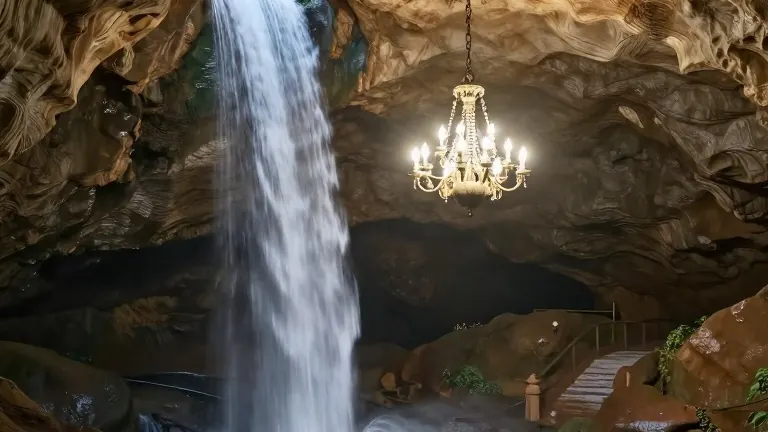
The rock at Laurel Caverns is a type of sandstone. Cale explained that calcium from ancient sea life mixed with sand grains to form a natural concrete. The site features a towering waterfall illuminated by spotlights, with water flowing into a pool beneath the trail.
Cale’s family bought the land as a farmstead in the 1930s. His grandfather opened the caverns for tours in 1964. Cale helped string chandeliers in passages, including the Discovery Passage, which was uncovered in the late 1700s. He suspended the lights in midair using chains to keep the walls free of cement and repairs that would alter the original structure. The passage is about the length of a football field. Cale said he was heartbroken when his grandfather sold the farmstead in 1969. Two lawyers purchased the property and hired Cale to keep tours running. Developers later wanted to build homes above the caves, which Cale said would have placed several hundred septic tanks over the cave and affected its hydrology. Cale found an investor in 1973 to help preserve the site. He bought out that investor a little over a decade later. In 1994, he created the conservancy that still offers tours. Mike Mumau, a state parks official who leads the division including Laurel Caverns, said the state is at work on a short trail at the visitor center. He wants visitors who have traveled to have a chance to stretch their legs above ground on a nice day. Mumau is also focused on bats. In the winter, when the caverns are closed, they become a seasonal bat habitat. Before white nose syndrome, a fungal disease that decimated regional populations, the site hosted 1,500 to 2,000 bats. This past spring, the park observed fewer than 15 bats wintering on site. The state plans to modify bat gates to help them return. Cale said he is excited about the park's next chapter. He noted that many of his classmates are dead now. He said it is better that he lived to see what he wanted the site to be. Cale said he made a promise to the cave to take care of it. He said he kept that promise.
Source: WVPB · original report published
More News · Charleston news · Report a business · Got a Story?